The Best Intercom Alternatives for B2B Software Teams

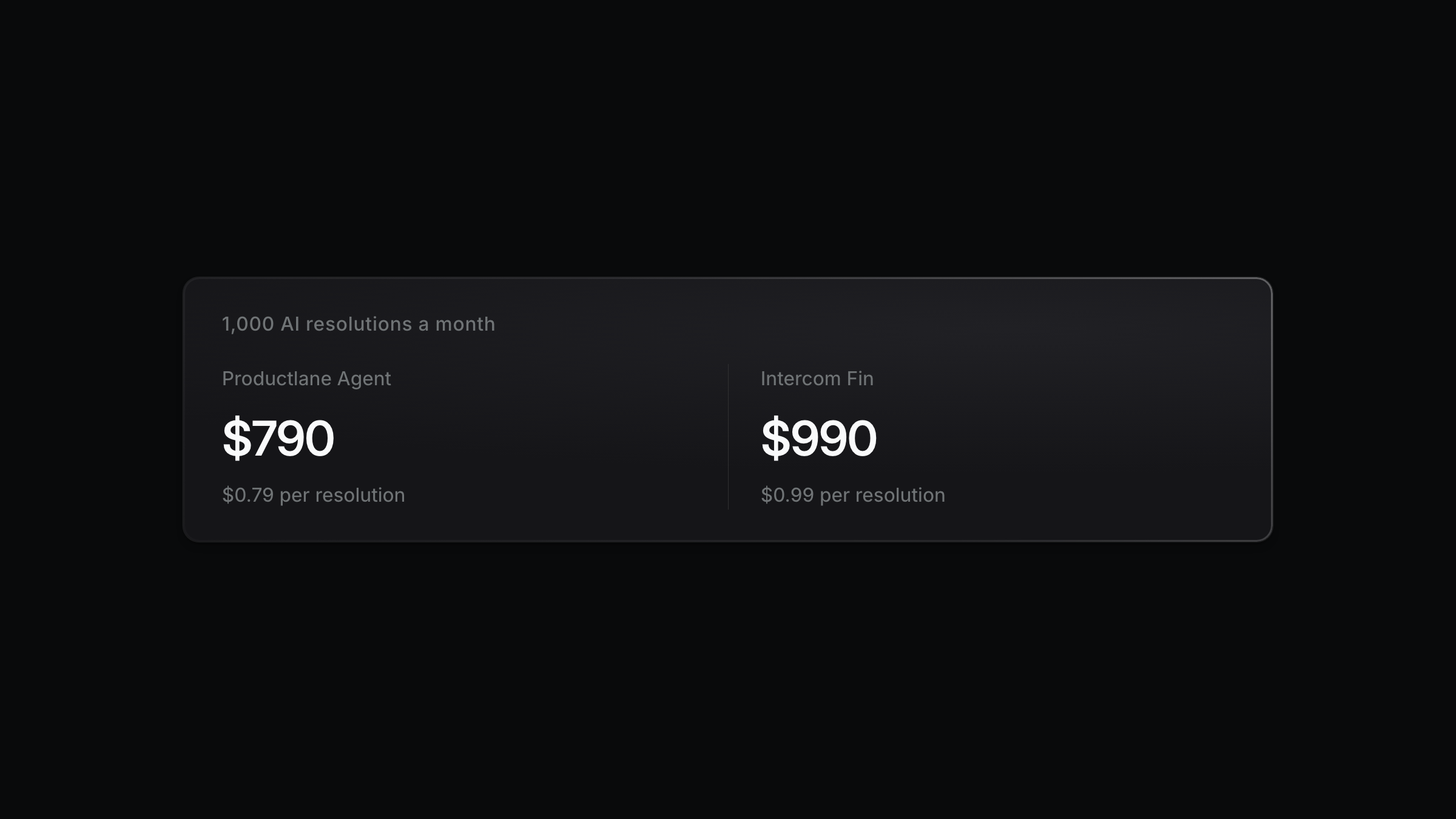
Teams leave Intercom for three reasons: the bill grows in two directions at once, the product carries a decade of features aimed at B2C ecommerce, and the AI agent is priced per resolution on top of seats you already pay for. Productlane is the closest fit for a B2B software company: the AI agent runs at $0.79 a resolution against Fin's $0.99, seats are $29 each per month on the yearly plan, and the agent files Linear issues and closes the loop with the customer when the fix ships. Plain suits API-first teams, Pylon suits Slack-heavy enterprise support, and Zendesk remains the pick if you need a full contact center. Below: why teams switch, five alternatives with the cases each one wins, what actually has to move during a migration, and the questions to ask on a demo.
Intercom is a good product with a pricing model that surprises people. It sells seats on three tiers, then bills its AI agent, Fin, separately at $0.99 for every conversation Fin resolves. Both numbers grow as you grow. A team that doubles its customers pays more for seats to serve them and more for the agent that deflects them.
The other reason teams look elsewhere is fit. Intercom was built for high-volume consumer messaging, and it still shows in the shape of the product. If you sell software to other companies, a lot of what you are paying for is aimed at somebody else's problem.
This piece covers what actually drives the switch, the alternatives worth a demo, and the parts of a migration that are genuinely annoying.
Why teams leave Intercom
Three complaints come up repeatedly, and they are worth separating because only one of them is about money.
The bill has two axes. Seats start at $29 a month on Essential, rise to $85 on Advanced, and reach $132 on Expert, billed annually. Fin is charged on top at $0.99 a resolution. The seat tier you need is usually decided by one feature buried in the higher plan, so teams end up on Advanced for a single capability and pay the difference across every seat.
The product is broad. Intercom covers marketing tours, outbound campaigns, and consumer messaging alongside support. Breadth is genuinely useful if you need it. For a B2B software team it means a settings surface where most of the options never apply to you.
The loop stays open. A customer reports a bug, support confirms it, and somebody retypes the report into the engineering tracker. When it ships weeks later, nobody remembers who asked. This is not specific to Intercom, and it is the single biggest gap in most support stacks.
Five alternatives worth a demo
| Tool | Wins when | AI pricing |
|---|---|---|
| Productlane | You sell software, your engineers work in Linear, and you want support, docs, changelog, and roadmap in one tool. | $0.79 per resolution |
| Plain | You want an API-first support platform and your customers live in Slack Connect, Teams, and Discord. | Usage based |
| Pylon | You run enterprise support through shared Slack channels and need account-level intelligence. | Per seat |
| Zendesk | You need a full contact center: voice, workforce management, and deep compliance reporting. | Per seat plus AI add-on |
| Help Scout | You want a simple shared inbox and a help center, with no interest in an agent yet. | Per seat |
The honest summary: if you need voice and a contact center, Zendesk is still the answer. If you sell software to other software companies, everything else on that list fits you better than Intercom does.
What Productlane does differently
We build for one customer: a software company whose engineers already work in Linear. That focus buys a few things a general-purpose tool cannot offer.
The agent is opinionated, so setup is short. It reads your help center, changelog, roadmap, and resolved threads, and that is the configuration. There is no flow builder and no intent tree to draw, because a flow is a guess about which conversations customers will actually have. It resolves 65.3% of the conversations it joins.
Your support inbox, built on Linear
An AI agent answers from your help center, and every bug becomes a Linear issue.
Sign upWhen a conversation turns out to be a real bug, the agent writes the Linear issue itself, with the evidence it gathered and the customers waiting on it attached. When that issue ships, everyone who reported it hears back automatically. That is the loop most teams close by hand, badly, or never.
There is more on how the agent behaves in our guide to AI support agents.
What a migration actually involves
Migrations sound worse than they are, because the parts people worry about are the easy parts.
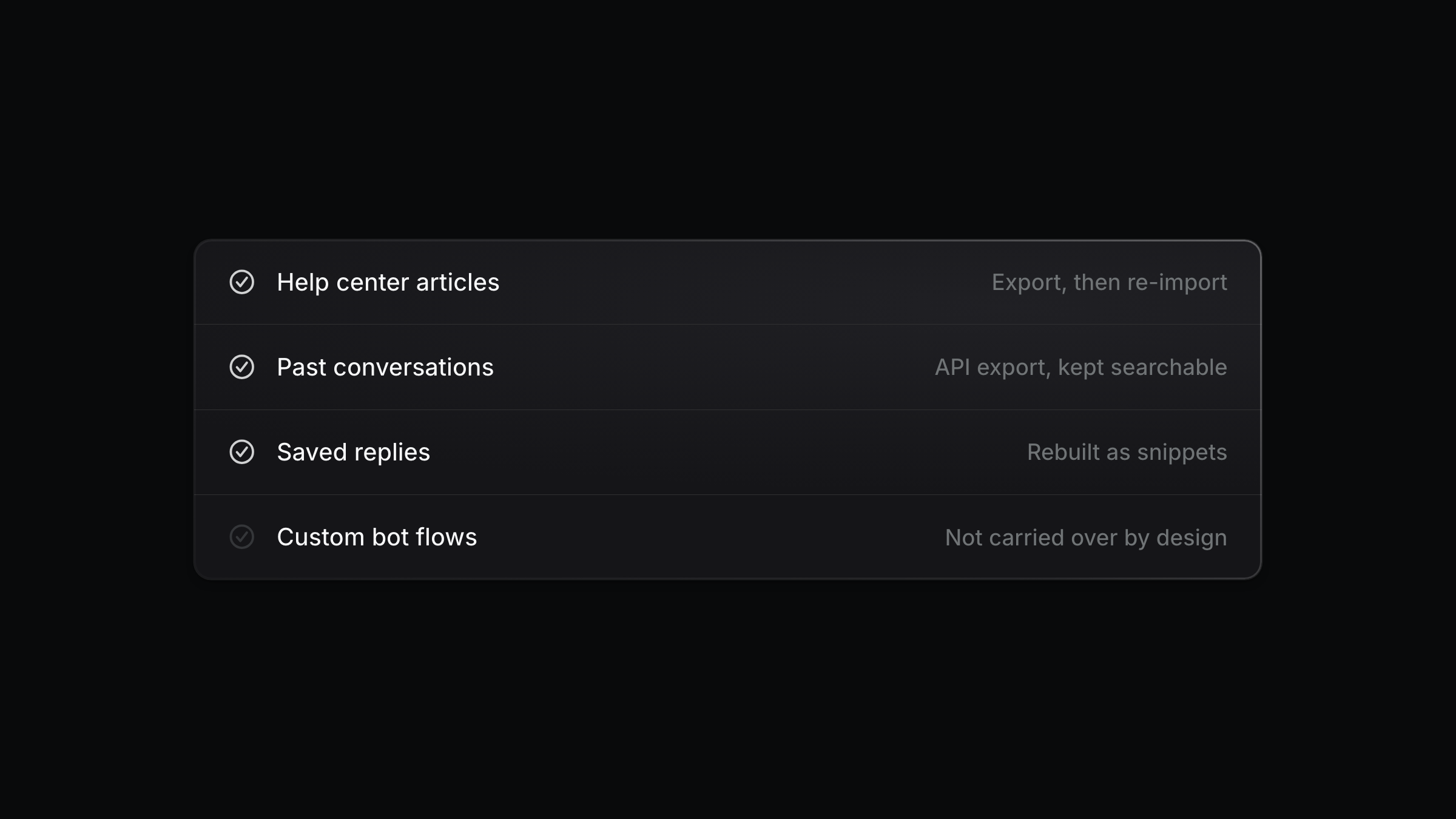
Articles and conversation history export cleanly through the API. Saved replies become snippets. The genuinely awkward item is your custom bot flows, and the awkwardness is that a modern agent does not want them. If you spent two quarters building a decision tree, throwing it away feels like a loss even when the replacement answers better.
Budget a week of overlap where both tools receive mail, and route a slice of real traffic to the new agent before you commit. Any vendor who will not let you do that is telling you something.
Questions to ask on the demo
Five questions separate the tools quickly, and none of them are about feature lists.
How long until the agent answers a real ticket? Hours means the product works out of the box, weeks means you are buying a configuration project.
Is the quoted number deflection or resolution? Deflection counts conversations no human touched, including the ones where the customer gave up. Resolution counts problems solved.
What does the human see when the agent hands over? The transcript and the account context should already be on screen.
What happens after the agent confirms a bug? Either it becomes a tracked issue automatically or a person retypes it.
What does the bill look like at three times my volume? Ask them to model it. The answer separates per-resolution pricing from per-seat pricing faster than any pricing page.
Frequently asked questions
It depends on what you sell. For a B2B software company whose engineers work in Linear, Productlane is the closest fit, because support, help center, changelog, and roadmap sit in one tool and the AI agent files engineering issues itself. Plain suits API-first teams with customers in Slack Connect. Pylon suits enterprise support run through shared Slack channels. Zendesk remains the answer if you need voice and a full contact center.
Seats are $29 a month on Essential, $85 on Advanced, and $132 on Expert, billed annually. Fin, the AI agent, is charged separately at $0.99 for each conversation it resolves. A five-seat team on Essential handling 1,000 conversations a month at a 50% Fin resolution rate pays roughly $195 in seats plus $495 in Fin fees.
The Productlane agent is $0.79 a resolution against Fin's $0.99, and seats are $29 each per month on the yearly plan. The larger saving is usually the seat tier rather than the per-resolution rate, since teams often move to a higher Intercom plan for one feature and pay that difference across every seat.
Yes. Articles and past conversations export through the Intercom API and import cleanly, and saved replies become snippets. Custom bot flows are the exception, and modern agents deliberately do not use them: the agent reads your documentation and past resolved threads instead of following a tree you drew.
Plan on a week or two, most of which is overlap rather than work. Import the help center and history, connect your channels, point a slice of real traffic at the new agent, and keep both tools receiving mail until the numbers hold up. The agent itself is useful on day one, because the material it reads is documentation you already wrote.
Make your customer support autonomous
- Customer support built for companies using Linear
- An AI agent that fully resolves customer tickets
- A help center that writes itself from your threads